
You’ve done it. You’ve booked your cruise and now you’re staring at a suitcase wondering how on earth to pack for a week at sea. What’s the dress code, exactly? Do you really need sunscreen every single day? And should you bring a power strip?
I get these questions often from my clients, and they make complete sense. You’re living on a ship, dealing with tiny closets, and switching between pool decks, port excursions, and elegant dining rooms. Knowing what to pack can feel overwhelming.
This Caribbean cruise packing list will walk you through exactly what to bring, what to skip, and a few cruise packing essentials I always make sure my clients don’t forget.
The Cruise Packing Essentials: Documents, Medications, and Things People Commonly Forget
First, let’s talk about the things that will actually derail your trip if you leave them behind, such as necessary cruise documentation and health-related items.
Cruise Documentation
- Passport: Even if your cruise is a closed-loop sailing from a U.S. port, I strongly recommend a passport over a birth certificate. If a medical emergency requires you to fly home from a foreign port, a birth certificate won’t help you at the airport.
- Photocopy of Passport: In addition to brining your physical passport book, it’s always a good idea to have a photocopy as well, in case the original gets lost or stolen.
- Cruise boarding documents: Print these. While mobile versions are available with most lines, it’s wise not to rely solely on your phone, since cell service can be spotty at some ports.
- Travel insurance documents: Yes, you need travel insurance. Purchase it early (usually within 14-21 days of booking to avoid preexisting conditions) and keep a copy of your policy in your bag. The best policies will offer support lines you can call if you experience a health emergency while sailing.
- Photo ID: Having a driver’s license as a backup to your passport is smart.
- Credit cards and cash: Most ships are nearly cashless, but you’ll want small bills for additional gratuities at ports and for local vendors in markets, as well as credit cards for handling airport or other expenses before and directly after your cruise.
- Luggage Tags: Most cruise lines will provide luggage tags for you to print and bring to the port. These should be part of the electronic document package you’ll be encouraged to download after online check in. Be sure to print these and bring them with you, but don’t put them on your luggage until you are headed to the cruise port. Plastic sleeves can be purchased
Medications and Health
Prescriptions: Don’t forget to pack prescription medications in your carryon bag in their original pharmacy containers. If your cruise embarks from a foreign port, you may be asked for proof that the medication you are carrying is prescribed by a physician. A signed letter from your doctor usually puts this concern to rest, but you should still carry all prescriptions in their original containers with labels attached.
Pro Tip: Pack more medication than you think you need — Pack extra doses of medications, one in your carry-on and one in your checked luggage. If a bag goes missing, you’ll be glad to have a second stash.
Motion sickness remedies: Even people who don’t typically get seasick can feel queasy on a rough sea day. Bring Dramamine or Bonine, or ask your doctor about a prescription patch before you go.
Common over the counter remedies—While no one likes to think about it, catching a cold or other common ailment on a cruise ship is possible. If it happens, you’ll be glad to have your favorite cold medications and pain relievers on hand. The ship’s stash is likely to be limited and quite costly when compared to what you’d pay at home.
Over the counter medications to bring onboard include:
- Pain reliever
- Cough suppressant
- Sinus medication
- Anti-diarrheal
- Motion sickness medications
- Allergy medications
- Vitamins you commonly take
- Anything else you might use at home
- Bandages and mole skin: When cruising, you may find yourself walking more than you are accustomed to, meaning even worn and comfortable shoes could start to rub a blister. Mole skin can help prevent these sores and bandages are important if a blister should develop.
Tech and Power: Charging Your Devices
This is where I see a lot of first-timers get caught off guard. Cruise ship cabins typically have one or two outlets — that’s it. On some cruise lines, the voltage is international, leaving US cruisers in a quandary.
To ensure you have enough outlets to charge your devices, bring a power strip without a surge protector (surge protectors are prohibited on most ships) or a multi-port USB charging hub. It’s genuinely one of the best small packing decisions you can make.
PRO TIP: Be sure to check the cruise line’s prohibited items list before you start packing. Some cruise lines, like Disney, prohibit the use of power strips while on board, even if they are not surge protected.
Other tech worth packing:
- A waterproof phone case or pouch — For beach days and water excursions.
- Portable charger — Long days at ports mean long days away from your cabin outlet.
- Adapters if you’re sailing internationally — Check your cruise line’s onboard outlet specs if you’re going to Europe or other international destinations. These ships may employ European outlets that require an adapter for use by U.S. devices. However, most Caribbean sailings departing from the U.S. use standard plugs.
Caribbean Cruise Packing List: What to Wear When
When it comes to packing for a Caribbean Cruise, most cruisers tend to overpack, thinking they will wear more than they actually do. A good rule of thumb for daytime is to think about what you’d wear at home and pack accordingly. If you typically wear a pair of shorts twice in a week before needing to wash them, plan the same for your cruise. Taking this approach over planning a new outfit for every day will give you more space for packing clothes you need for dinner each night.
Caribbean Cruise Packing for Daytime and Pool Deck
Average high temperatures in the Caribbean range from the mid-70s to upper 80s Fahrenheit, with summer temps reaching into the 90s. Given the heat, you’ll want to pack lightweight, breathable fabrics. A week-long sailing typically needs:
- 2-3 swimsuit bottoms and 2–3 tops — You can rinse suits in the sink and dry them in the cabin.
- Cover-ups and lightweight shorts — For moving between the pool and your stateroom or lunch. Some ships allow cover-ups in the buffet dining area, while others require a shirt and pair of shorts. Be sure to know which your line accepts before packing.
- 1–2 casual sundresses or resort-style outfits — Great for sea days and casual lunches or dinners.
- A light layer — The ship’s air conditioning can be cold. Bring a light cardigan or long-sleeve layer for indoor dining or onboard activities, such as trivia or bingo.
- Sunscreen – Getting burnt on vacation is no fun. Be sure to pack a high SPF sunscreen and have enough to reapply throughout the day
- Towel clips or bands – Winds on the pool deck can be strong, capable of easily sending your towel into the pool on some days. Towel clips or bands will help hold your towel to your lounger, even if you get up to take a dip.
Dinner and Evening Attire to Pack
Most mainstream cruise lines have two to three formal or “cruise elegant” nights on a seven-night sailing, with the remaining evenings being smart casual. Smart casual means no shorts or flip-flops in the main dining room.
On most lines, dress is fairly flexible on most line. Women tend to dress in a variety of styles from a cocktail dress to a blouse with trousers. Men can wear a dark suit or a dress shirt with slacks. Very few ships still require a tuxedo.
- 2 formal or dressier outfits — For the formal nights
- 2–4 smart casual evening outfits — These can overlap with nicer daytime outfits if you pack strategically – don’t be afraid to wear something to dinner twice
- Comfortable dress shoes — Think flats or low heels. You’ll be doing a lot of walking just to get to the dining room from your stateroom.
Pro Tip: Women can easily wear the same dress to dinner multiple nights in a row by selecting something in a neutral solid color, such as black, and topping it with different jackets, sweaters or a belt. The jackets or sweaters can also double as your light daytime layer if the air conditioning is too cold. A t-shirt dress can be a great staple, something you can dress up or down depending on the layer you wear over it or how you accessorize it.

Cruise Packing Essentials for Shore Excursions
Packing for shore excursions will naturally depend on the type of experiences you book. If you’re heading out on horseback, you’ll want long pants for that day, while a day at the beach may require water shoes and a bathing suit. For typical Caribbean ports, plan for:
- Comfortable walking shoes or sneakers — Cobblestones are everywhere in historic port towns and require sturdy shoes.
- Water shoes or reef-safe sandals — For beach and snorkeling days
- A wide-brim hat — Shade is not always available at ports and the Caribbean sun at midday is not gentle
- A lightweight rain layer or packable poncho — Quick afternoon showers are common. A 10-minute downpour can happen even on a beautiful day.
- Beach bag or backpack — Your cruise line will provide towels for any beach excursion you book through the line, but you’ll need to bring your own bag to carry them, as well as other beach essentials, such as sun screen and water shoes. A smaller bag for other shore excursions will make it easier to carry portable chargers, your wallet and any medications you might need.
Stateroom Essentials for your Caribbean Cruise

Unless you’re booking a large suite with multiple rooms, you will probably find your stateroom cabin a tighter squeeze than you’re accustomed to. While most ships offer efficiently arranged space for storing items and getting them out of the way, a few extra essentials can help you make better use of the available space:
Charging blocks and long charging cords – If you’re traveling with a number of devices that need to be recharged each evening, you’ll soon realize there aren’t enough electrical outlets in your room for multiple charging blocks. That’ why a single block with multiple ports is an essential. Just be sure to bring extra long USB or USB-C charging cables if you like to look at your phone while it charges at night. On many ships, outlets are not near the bed.
Lanyard: With only a few exceptions, ships will issue you a shipboard card for making purchases, entering your stateroom and getting on and off the ship. With so much functionality tied to the card, you will be taking it everywhere with you. A lanyard and card holder make it easy to carry and keeps your card convenient for when you need to use it.
Magnetic hooks: Small magnetic hooks that adhere to the metal walls of your stateroom make it easy to stow away lightweight items like hats, jackets and even your ship card on a lanyard.
A reusable water bottle — Drinking bottled water onboard will cost you, unless you have a drink package, so many cruisers carry a refillable water bottle from home. Refill stations onboard allow you to keep hydrated without continuously seeking out a water fountain.
Caribbean-Specific Items: What the Climate and Ports Require
Not every cruise packing list accounts for where you’re actually sailing. The Caribbean has its own demands, requiring attention to certain details when sailing.
Reef-safe sunscreen — Many Caribbean ports and beach operators now require or strongly encourage reef-safe formulas to protect the coral.
Insect repellent with DEET — Mosquitoes in tropical ports are no joke, particularly in the evenings and in jungle or rainforest excursion areas.
A dry bag — If you’re going snorkeling, kayaking, or on any water-based excursion, a small dry bag protects your phone, cash, and anything else you don’t want wet.
Cash in small denominations — It’s customary to tip drivers and guides on your shore excursion, and U.S. dollars are accepted widely throughout the Caribbean for tips. You may also want higher denomination bills on hand if you plan to tip onboard staff above and beyond the customary ship assessed gratuity.
Additional Items you Can’t afford to Miss
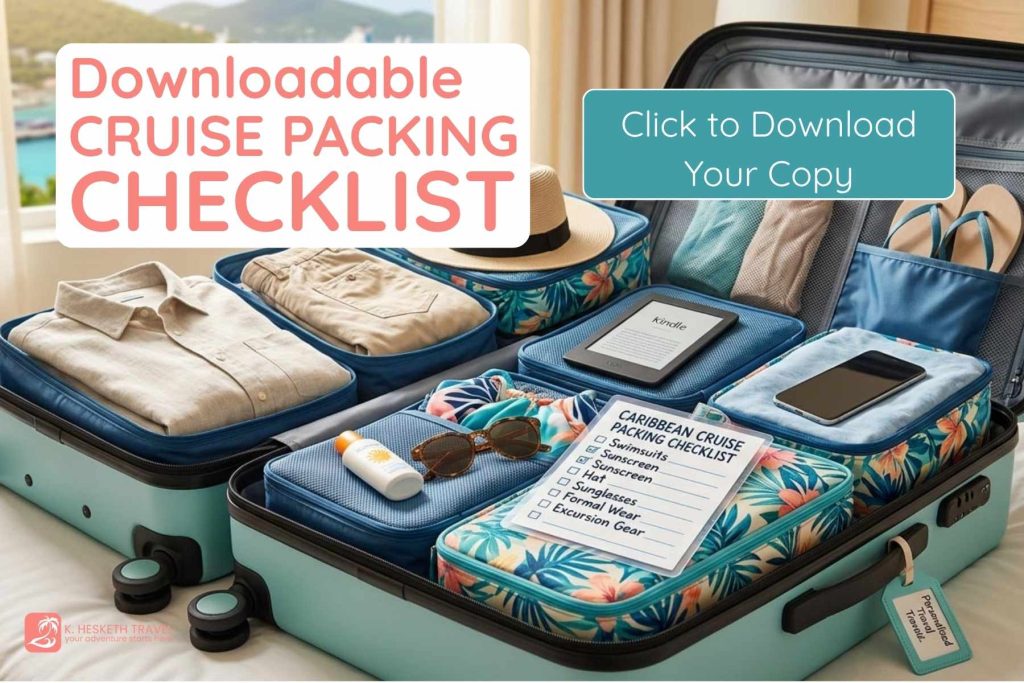
Be sure to download my complete Caribbean Cruise Packing Checklist, to make sure you’re prepared for your next cruise.
What NOT to Bring: Prohibited Items and Things That Waste Space
I always tell my clients that what you don’t pack is just as important as what you do. Here’s what to leave at home.
Prohibited Items
Most cruise lines prohibit these outright — check your specific line’s policy, but these are nearly universal:
- Surge-protected power strips — Fire hazard. Bring a basic power strip without surge protection if needed and allowed.
- Irons and steamers — Ships have laundry facilities and pressing services. An iron in your cabin is a fire risk and not allowed.
- Outside alcohol — Most lines allow you to bring a bottle or two of wine in your carry-on on embarkation day, but hard alcohol from ports will typically be collected and returned on the last night. Know the policy before you buy or try to bring something onboard from home.
- Drones — Prohibited on nearly every ship and at many ports.
- Large scissors or tools — TSA rules apply on embarkation day at the terminal just as at airports.
Things That Waste Space
- Too many formal outfits — Two formal nights means two formal outfits. Pick your favorites and leave the rest at home
- Full-size toiletries — Full size shampoo, conditioner, and body wash can take up a lot of space and add weight to your suitcase that you probably can’t afford. Consider buying travel size bottles of common toiletries or buying refillable travel size empties and filling them yourself.
- A hair dryer — Your cabin has one, and yours most likely won’t be allowed.
- Books you won’t actually read — While reading is a great way to pass the time on your cruise, books add weight to your suitcase and take up space. Opt to download books onto a tablet or Kindle, if you can. Otherwise, think carefully about how much time you will actually have to dig into a good book. Cruise ships are active places.
- “Just in case” outfits — If you’re packing something with the thought “I probably won’t wear this but just in case,” leave it home.
Kathleen’s Personal Packing Tips
These are the things I’ve learned that aren’t in any official checklist and don’t necessarily fit into other categories. Let’s call them miscellaneous packing tips.
- Pack your swim suite, medications and anything you need the first day onboard in your carry-on. On embarkation day, your larger suitcases will be checked and can take hours to arrive onboard. If you want to enjoy the pool as soon as you get onboard, pack a complete bathing suit, or anything else you may plan to change into once onboard, in your carryon.
- Bring a small over-the-door shoe organizer. This sounds strange, but you can hang it on the bathroom door and have more storage for sunscreen, chargers, medications, and everything else that would otherwise pile up on the tiny cabin desk. It keeps small items visible and accessible without taking up drawer space.
- Label everything. Not just your luggage — your water bottle, your sunscreen, your dry bag. Excursion groups are large and things get set down and forgotten. A piece of medical tape with your name on it costs nothing and has saved countless items.
If you’d like to read more about what to expect overall, I wrote a full guide on what to expect on a cruise as a first-timer that covers everything from how muster drills work to how to actually enjoy embarkation day.
And if you’re weighing cruise lines, my guides on the best cruise lines for travelers over 50 and the best cruise lines for families break down the real differences in experience, ship culture, and what to expect on each.
Ready to Plan Your Caribbean Cruise?
Choosing the right ship for your group, timing the booking to get the best stateroom categories, making sure your dining preferences and any special accommodations are sorted before you board — that’s where working with someone who does this every day really pays off.
If you’re thinking about a Caribbean cruise and want a single person handling the details from start to finish, I’d love to talk. There’s no extra cost to you — my services are commission-based through the travel suppliers — and you’ll have me as your point of contact from the first conversation all the way through embarkation day.
Reach out here and let’s start planning.
More Cruise Tips

Kathleen Hesketh is a travel advisor, travel writer, and lifelong explorer with more than a decade of experience helping travelers plan memorable vacations. As an affiliate of Main Street Travel, LLC, she specializes in cruises, Disney destinations, guided tours, and custom travel experiences for families, couples, solo travelers, and adults over 50. Kathleen is a graduate of Disney’s College of Knowledge, a CLIA-affiliated cruise professional, and a certified specialist with leading travel brands including Viking and Royal Caribbean. Through her travel website, K Hesketh Travel, she combines professional expertise with practical, real-world advice to help travelers plan with confidence.