
As you plan your first cruise, it’s common for the excitement to be mixed with uncertainty.
You’ve booked the trip. You’ve seen the photos. But you’re still wondering what to expect on a cruise. How do you check in, where do you board and what happens once you’re on the ship are all common questions first-time cruisers have.
This guide covers the essential first time cruise tips you need to feel prepared before you step onboard, with quick explanations you can explore in more detail as you plan.
Covered in This Guide:
- What to know about sea days and port days
- What’s included and not included in your cruise fare
- The importance of selecting the right stateroom
- Online check-in tips
- What to expect on embarkation day
- Tips to simplify dining confusion
- When to arrive for your cruise
- Navigating gratuities
- And more
First Time Cruise Tips #1: Understanding Sea Days vs. Port Days

One of the first things to understand is that you won’t be docked every day of your cruise. Depending on the itinerary one or more days may be spent at sea.
This is where the idea of sea days and port days comes into play.
Sea Days Are for Relaxing
A sea day is exactly what it sounds like: a day spent sailing.
These days tend to unfold slowly. Because people tend to get up later, maybe order coffee in their room, the ship can feel empty early in the morning. If you’re an early riser, you may be one of the first to appear for breakfast or at the coffee shop. If you’re looking for a time to explore a nearly empty ship, this is it.
However, there is one area of the ship that tends to see a fair amount of action on sea days, even early in the day, and that’s the pool deck.
Beware the Chair Hogs
Depending on the cruise line, you may notice that people start to spread belongings across chairs on the pool deck very early in the morning. This behavior is frowned upon by many cruisers, and some cruise lines have even started to take action against those who leave their belongings on a chair for too long unattended. However, it can still be a problem, making it difficult to secure a poolside chair on sea days.
If you’re looking for a tip to avoid the chaos, spend a little time on embarkation day scouting out alternative areas of the ship where you could spend some time outdoors. There are usually several hidden alcoves where you can wile away a day at sea.
Port Days Move Quicker
A port day has a different energy compared to a sea day. The ship often docks early at port, and it’s common for more passengers to be up and about with the sunrise. Many like to watch the ship dock, particularly if it’s the first port day. Other passengers are preparing for shore excursions.
On port days, passengers tend to rise early and leave the ship, meaning late morning through early afternoon can be one of the easiest times to enjoy onboard spaces, like the pool deck. While dining may be somewhat restricted, those venues that remain open have fewer crowds, and for some, a more enjoyable atmosphere.
First Time Cruise Tips 2: Know What’s Included on a Cruise (and What Isn’t)
Cruises are like a floating resort, offering food, entertainment and beautiful spaces for relaxing all in one fare. Once onboard you’ll find that many of the essentials have been taken care of for you and are covered in your fare, including:
- Your selected stateroom, including a daily stateroom attendant
- Certain bath products such as shampoo, lotion and conditioner (varies by line)
- All onboard meals, including tap water, coffee, and tea
- Most onboard activities
However, despite the all-inclusive nature of cruising, there are some hidden expenses that could catch you by surprise. First-time cruisers should be prepared to pay additional fees for:
WiFi service (if wanted or needed-packages available)
Alcohol and specialty drinks like flavored iced coffee (packages available)
Shore excursions
Dining at specialty restaurants
Spa and salon treatments
Transportation to and from the port on embarkation and disembarkation day
First Time First Time Cruise Tips 3: Selecting the Right Stateroom
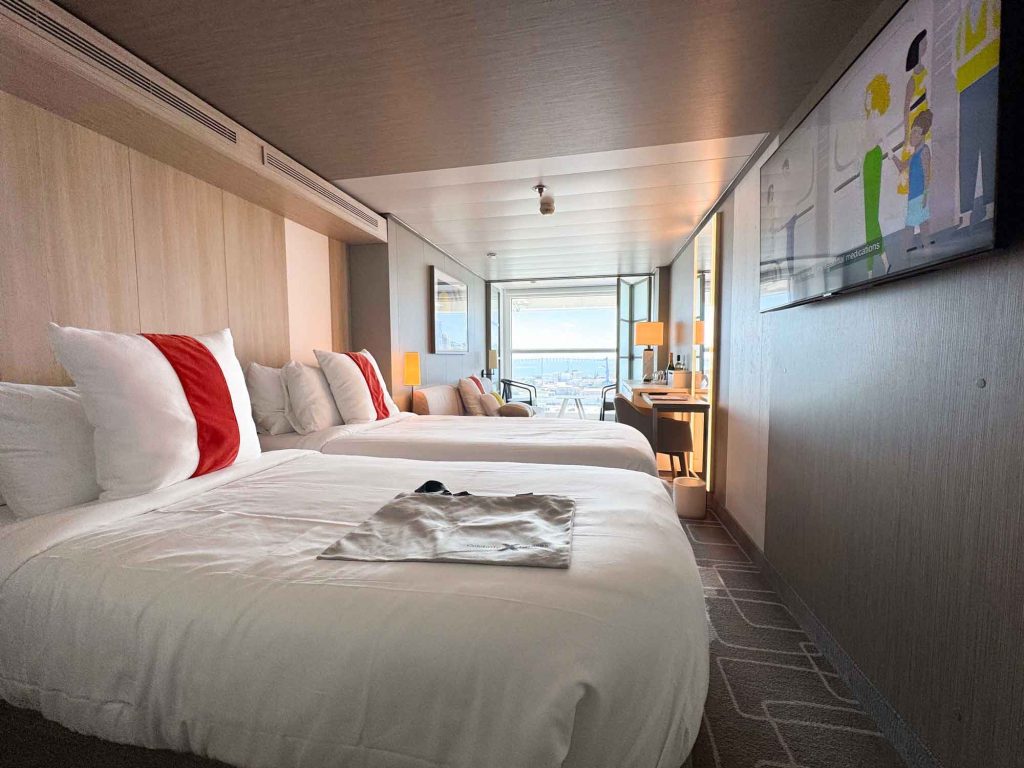
At first glance, selecting your stateroom might seem like a simple decision. It’s just a place to sleep, so why not select the one with the cheapest possible fare?
But once you’re onboard, you start to notice how it shapes your experience.
An interior cabin feels quiet and cocooned, perfect for travelers who plan to stay busy and not spend much time in their stateroom. These rooms have no windows, are usually smaller than other cabin types, and can begin to feel claustrophobic for some passengers over a week-long voyage.
An ocean view stateroom offers a little more connection to the cruising experience and some light to your room. You’ll have at least one window and a little more space to move around when compared to interior cabins.
For many guests, a balcony stateroom is the pinnacle of the cruising experience. Rooms are often larger and offer doors to private outdoor spaces overlooking the ocean. On some ships, like Celebrity Edge class ships, the balcony area is an extension of the room with a slide down window, allowing you to create or seal off your balcony at will while, gaining more stateroom floor area.
Suites and staterooms in exclusive areas of the ship are also available, but choosing a stateroom isn’t about selecting the most expensive option. It’s about choosing the one that fits how you want to experience the trip.
If you plan to spend every day out and about, returning to your stateroom just in time for your head to hit the pillow, an interior stateroom might be right for you. But if you plan to spend any time at all in your room, opt for the ocean view or balcony stateroom. You’ll be glad to have the extra space, the light and the view.
Pro Tip: Beware the Guaranty Fare
Most cruise lines offer a guaranty fare. On the surface this might sound like a great deal. After all, you can book the stateroom class you really want, maybe even bumping up to an ocean view or balcony, for less than the cost of the usual fare for that room.
Here’s the catch. The cruise line gets to select where that stateroom is located. While they do guarantee you’ll be placed in the cabin category you book, that room may be located anywhere on the ship—forward, aft, midship, and even above the night club that rocks all night long. If you want to sleep late in the morning, go to bed early or spend time in your stateroom, it’s worth it to pay extra and select your own stateroom location.
First Time Cruise Tips 4: Download the Cruise App Early
Every cruise line has an app, and most offer plenty of functionality once onboard. You’ll find daily itineraries of shipboard activities, deck plans, and hours for onboard restaurants to name a few of the app’s critical offerings.
However, if you wait to download the app, you may miss out on much of its functionality. Depending on the line, the cruise app can be a planning tool as well, helping you find answers to questions, make dining reservations and to inform other decisions about your trip.
If you’re looking for an important, although seemingly inconsequential cruise planning tip, it’s to download the cruise line app, create a profile and link your reservation as soon as you book your cruise. Keep reading for more things you can do with the cruise app in the days leading up to your cruise.

First Timer Cruise Tip 5: Plan at Least a Few Port Days in Advance
While you may not feel the need to extensively visit every port on your itinerary, odds are, you will want to experience some of what each has to offer. This is all the more likely on bucket list adventures to places like Alaska or the Panama Canal.
Unfortunately, if you wait until you are onboard to book, you may find that some of the best adventures are sold out. Plan to look over the list of shore excursions as soon as they are available and book the ones you are most interested in joining.
Pro Tip: Cruises may offer sales on shore excursions in the days leading up to your cruise. Don’t let the fear of missing a reduced price leave you standing on the dock on a port day. Go ahead and book early. If a reduced price comes up, you can always cancel and rebook. Watch your email for announcements on reduced shore excursion pricing.
Cruise Tip 6: Complete Online Check-in
A few weeks to a few months before your cruise, depending on the line, you will be asked to complete an online check-in process using the app or your online account. Completing online check in before embarkation day can save you a significant amount of time at the port. During this process, you’ll typically:
- Upload your travel documents, such as a passport
- Add a payment method for your onboard account
- Select or confirm your arrival (boarding) time
- Complete health and contact information
One of the biggest benefits of checking in early is access to better arrival times. The earlier you complete check-in, the more likely you are to secure a preferred boarding window—which can mean shorter lines and a smoother start to your trip.
Waiting until the last minute can limit your options and add unnecessary delays on embarkation day.
It’s also worth double-checking everything you submit. Small errors—like a misspelled name or incorrect document details—can slow things down when you arrive at the port.
Online check-in doesn’t take long, but it sets the tone for your entire cruise experience. It’s one of those small steps that can make everything that follows feel much more seamless.
First Timer Cruise Tip 7: Know What to Expect on Embarkation Day
Embarkation day is often the part first-time cruisers worry about most—and for good reason. You’ll be arriving at a port, going through security, and figuring out where to go next—all while surrounded by hundreds of other passengers doing the same thing.
The good news is that it’s far more organized than it sounds.
Most cruise lines assign an arrival window, which helps spread out crowds. Once you arrive at the port, you’ll move through a step-by-step process: document check, security screening, and final boarding. It’s similar to an airport, but typically more straightforward.
Where first-time cruisers run into stress is usually timing and expectations.
Arriving too early can mean waiting longer than necessary, while arriving too late can create unnecessary pressure. Aim to arrive within your assigned window, not before or after.
Pro Tip: Planning for Navigation Headaches
Some ports are very isolated, with only one road leading into and out of the port area. When this is the case, a simple 5 minute drive from your hotel to the pier can take an hour or more. Be prepared for traffic on embarkation day, particularly if you are boarding in the morning, and remember, you can always board after your boarding window, just not before.
Cruise Tip 8: Dining on a Cruise Is Easier Than You Expect
Dining is one of the areas where new cruisers may face confusion. Cruise ships have a reputation as one long floating buffet, but you’ll find more dining options onboard today’s ships than the buffet line on cruises of old.
Most lines have at least one main dining room in addition to the buffet, where passengers can experience sit-down fine dining. Appetizers, entrees and desserts are all included in the cost of your fare, and your server will rarely say no if you want more than one of something.
Your dining time will be selected when you make your booking. Most lines offer an early and a late seating, but more ships are now offering free choice dining, allowing you to arrive when you’re hungry and wait for the next available table.
Specialty restaurants are another option for dining variety. These establishments do cost extra but offer more dramatic elements of theming or cuisine, making them well worth the upgrade for some passengers.
Dining Pro Tip
On many ships, it’s common for passengers to be assigned a table in the main dining room with fellow travelers. This dining assignment remains in effect for the duration of the cruise. However, if you find the table not to your liking or wish to be seated with different passengers, have a chat with the maître d. He or she should be happy to move you provided they have the availability.
Cruise Tip 9 for First Timers: How to Navigate the Ship Without Feeling Lost
One of the most common concerns for first-time cruisers is surprisingly simple: What if I get on the ship and have no idea what I’m doing?
Cruise ships can feel overwhelming at first. They’re large, busy, and full of options. But the experience is designed to become intuitive quickly. The best tip is to focus on orienting yourself early:
- Take 20–30 minutes on your first day to walk the main decks
- Locate key areas like dining rooms, the pool deck, and guest services
- Open the app and look at what’s happening that evening
Most first-time cruisers find that by day two, the ship starts to feel familiar.
Cruise Tip 10: Gratuities Aren’t Included in Your Cruise Fare
Gratuities are one of the most common points of confusion for first-time cruisers—and with good reason.
On most cruise lines, gratuities are automatically added to your onboard account as a daily per-person charge. This covers the crew members who support your experience behind the scenes, including your cabin steward and dining staff.
To pay gratuities, you typically have two options:
- Prepay gratuities before your cruise by accessing your online account or contacting your travel agent
- Have gratuities added daily to your onboard account and charged at the end of your cruise to the credit card you place on file during online check-in
While it is technically possible to adjust gratuities at guest services, this is not common practice unless there’s a service issue. In fact, many cruisers pay their gratuities and then hand extra cash to crew members who go above and beyond at the end of the cruise.
First Timer Cruise Tip 11: Know When to Arrive for Your Cruise
Timing your arrival is one of the simplest ways to reduce stress on embarkation day.
The most important rule is this: arrive at least one day before your cruise if you’re flying.
Flight delays, cancellations, and missed connections are one of the top reasons travelers miss their cruise entirely. Arriving the day before gives you a buffer to reschedule cancelled or missed flights without missing the ship’s departure time.
If you’re driving to the port, aim to arrive ahead of your assigned check-in window. Remember, it can take time to navigate port traffic, find parking and arrive at the terminal.
Cruise Tip 12: Will Your Phone Work on a Cruise?
This is one of the most misunderstood aspects of cruising—and where unexpected charges can happen if you’re not careful.
Once your ship leaves port, your phone will no longer connect to standard cell service. Instead, it may pick up a maritime network, which can result in extremely high roaming charges.
The safest approach is simple: Put your phone in airplane mode as soon as you board.
From there, you have two main options for connectivity:
- Ship Wi-Fi: This allows you to browse the internet, check email, and use apps like FaceTime, WhatsApp, or Facebook Messenger for calls and messages. However, there is a charge, and you typically cannot make traditional phone calls unless you use a messaging app like Facetime or you’re connected to a cellular network in port.
- eSIM or international plan: Some travelers use these for port days, but they won’t always work while the ship is at sea unless connected to land-based towers. If you wish to have connectivity while sailing, you will need an eSIM that connects to maritime satellite networks.
Pro Tip: Avoid Costly Charges in Port
When you’re in port, your phone will usually reconnect to a local network, and this is another area where charges can add up quickly depending on your carrier and plan. If you don’t have an international plan, it’s best to put your phone in airplane mode to avoid accidentally connecting to the network or to contact your provider before departure about international day plans.

First Time Cruise Tip 13: How Does Disembarkation Work?
Disembarkation is the final step of your cruise—and it’s more structured than the rest of your trip.
The night before departure, you’ll receive instructions that outline:
- When to have your luggage packed and placed outside your cabin (if using luggage service)
- Your assigned departure group or time
- Where to go when it’s time to leave the ship
Most passengers are required to vacate their cabins early in the morning, even if their departure time is later. Breakfast is usually served in a limited number of venues.
As for staying onboard longer, the answer is generally no. Once disembarkation begins, passengers are expected to leave in an organized flow. You may be able to remain in public areas for a short time depending on your group, but this isn’t designed to be an extension of your vacation.
Once you’ve disembarked and are back on land, you’ll be able to pick up your checked luggage inside the cruise terminal. With luggage in hand, it’s time to leave the ship. At times you may be asked to undergo a post-cruise screening by showing your passport or undergoing a facial scan At other times, you may be asked to skip this step.
Pro Tip: Strategic Disembarkation
If you have an earlier flight or want more time to explore the port city, consider carrying your own luggage off the ship. This often allows for an earlier exit and more control over your timing.
Final Thoughts: Why Cruise Tips Matter for First-Time Cruisers
Your first cruise isn’t just about the destinations you visit. It’s about discovering a new way to travel—one where the journey and the destination are part of one grand adventure. But what makes the biggest difference for first-time cruisers isn’t luck—it’s knowing what to expect before you go.
That’s where these cruise tips for first timers come into play. They’re not about overplanning your trip or trying to control every detail. They’re about eliminating the small surprises that can cause stress—so you can focus on actually enjoying the experience.
Because once you understand how cruising works, everything is easier and navigating the experience becomes intuitive.
More Cruise Planning Tips



Kathleen Hesketh is a travel advisor, travel writer, and lifelong explorer with more than a decade of experience helping travelers plan memorable vacations. As an affiliate of Main Street Travel, LLC, she specializes in cruises, Disney destinations, guided tours, and custom travel experiences for families, couples, solo travelers, and adults over 50. Kathleen is a graduate of Disney’s College of Knowledge, a CLIA-affiliated cruise professional, and a certified specialist with leading travel brands including Viking and Royal Caribbean. Through her travel website, K Hesketh Travel, she combines professional expertise with practical, real-world advice to help travelers plan with confidence.
1 thought on “What to Expect on a Cruise: Cruise Tips For First Timers”
Comments are closed.